
Managing TISAX Security Incidents and Customer Notifications
Managing TISAX incidents requires a tested response process and customer notifications that reflect your contractual and legal obligations. Your organisation needs to contain the incident, preserve evidence and communicate confirmed facts without waiting for the investigation to finish.
For suppliers in the automotive industry, an incident can threaten confidential designs or interrupt production across the supply chain. Clear decision-making authority helps your team respond promptly whilst protecting customer relationships. Start by separating operational response, customer communication and assessment responsibilities.
Key takeaways
Establish reporting routes that employees, contractors and relevant suppliers can use during an outage.
Base customer notifications on contractual triggers and applicable law, rather than an assumed universal TISAX deadline.
Keep incident records, recovery evidence and corrective actions available for assessment.
Treat the ENX Portal as an assessment-results exchange, not an incident-reporting channel.
What TISAX adds to your security programme
An automotive assessment and exchange framework
The ENX Association developed TISAX with the VDA to support consistent automotive information security assessments. It uses the VDA Information Security Assessment catalogue, also called the VDA ISA catalogue, which incorporates ISO 27001 requirements and automotive-specific expectations.
Although people search for TISAX certification, TISAX produces assessment results and labels rather than conventional certification. Participants selectively share results through the ENX Portal; the results aren't public. Sharing can reduce repeated customer assessments, but a TISAX label doesn't guarantee that incidents won't occur.
How it differs from ISO 27001
ISO/IEC 27001 defines requirements for an information security management system, or ISMS, across industries. TISAX applies assessment objectives, scope requirements and evidence expectations for the automotive industry.
Existing risk assessments and ISO 27001 auditing records can support preparation. However, they need mapping to the relevant automotive activities and locations. Our guidance on TISAX requirements explains why an existing certificate doesn't automatically produce a TISAX label.
ISA 6.0 incident and crisis controls
ISA 6.0 strengthened incident handling, crisis management and recovery. ENX introduced it for assessments commissioned from 1 April 2024, whilst permitting previously commissioned ISA 5 assessments to continue under the earlier rules.
The ISA version 6 announcement provides the background to these changes. ISA2027 applies to assessments ordered from 1 January 2027, so the commissioning date matters when planning assessment evidence.
These controls connect reporting with operational recovery.
ISA control | Operational focus |
1.6.1 | Accessible mechanisms for reporting security events. |
1.6.2 | Timely, coordinated handling of events and incidents. |
1.6.3 | Preparation for crisis situations and crisis management. |
5.2.8 | IT service continuity planning. |
5.2.9 | Backup and recovery arrangements. |
Together, these controls require more than an incident response document. Staff and relevant suppliers need a reporting system for security incidents to report suspected events promptly. Assigned responsibilities and recovery arrangements must also work under pressure.
A reportable event doesn't have to be a confirmed breach. Suspicious access, lost equipment or unexpected system behaviour may require investigation before classification. Therefore, staff should report concerns promptly rather than decide whether an incident meets a customer-notification threshold themselves.
Secure endpoint software management also supports prevention and containment. However, preventive controls don't remove the need for reporting and recovery arrangements.
Respond to TISAX security incidents systematically
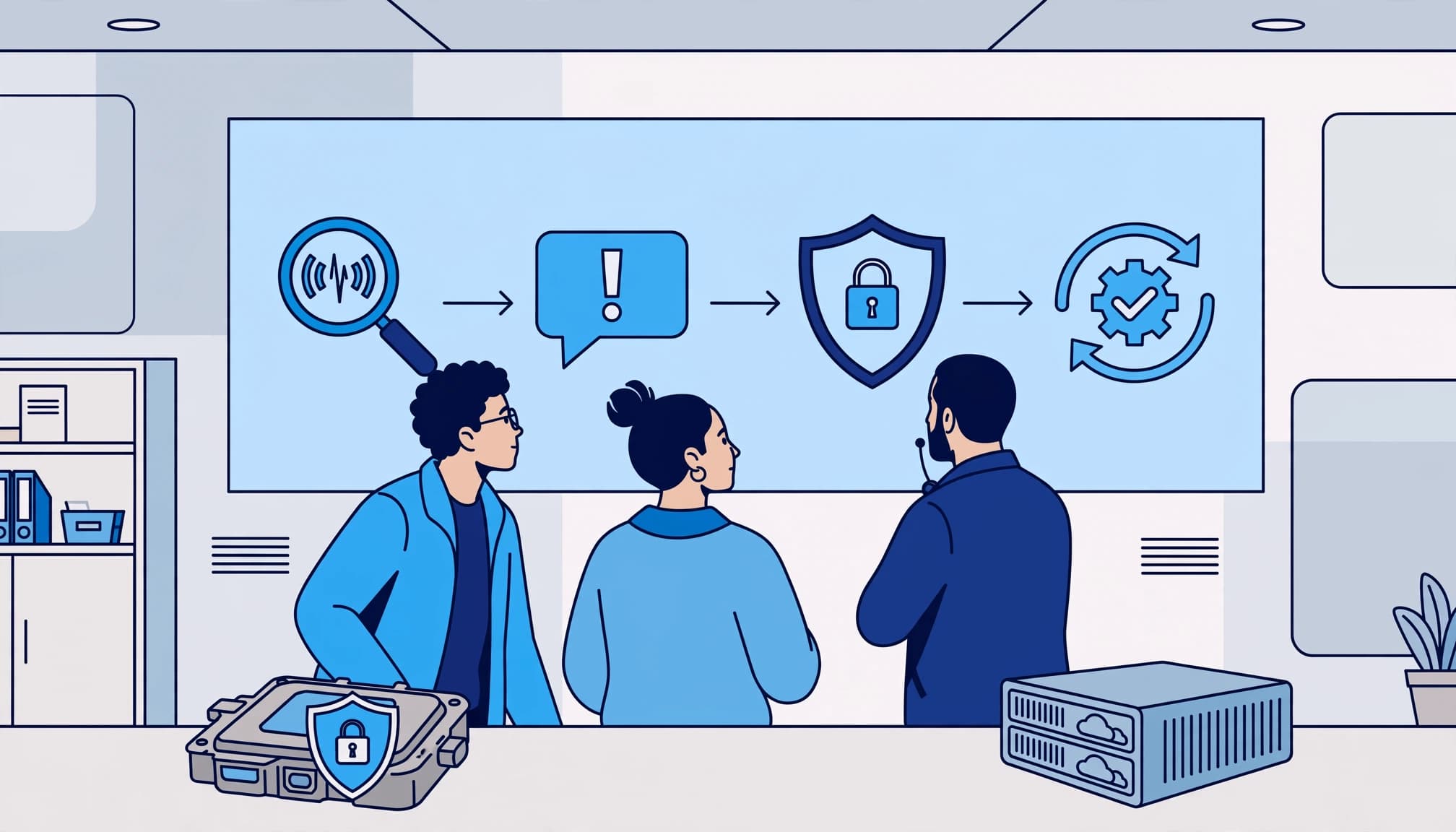
Classify the incident and assign authority
An information security incident is an event, or related events, that compromises or threatens information confidentiality, integrity or availability. Examples include ransomware, unauthorised disclosure of engineering files or loss of access to a production-support service.
Use the incident response plan to guide initial triage and assess the incident's severity and scope. Record the discovery time, affected assets, reporting person and initial business impact.
Appoint an incident lead to coordinate technical teams and escalate decisions to technical, operational and customer-communication owners. Include shared services in the investigation, as a compromised identity platform or managed service can affect the supply chain and automotive operations beyond the assessed location. Our incident response planning guidance covers responsibilities and escalation arrangements.
Agree with any testing service provider how containment validation will be scoped and escalated. Preserve its test findings with the incident record.
Contain safely and recover under control
Containment should limit harm without unnecessarily destroying evidence or disrupting essential operations. Secure relevant system, access and network logs, along with decision records, before routine processes overwrite them.
For manufacturing environments, coordinate system isolation with production owners because abrupt disconnection can affect production or safety. Activate continuity arrangements if normal services can't continue.
Before restoring or reconnecting services, confirm that trusted backups are available, testing meets documented acceptance criteria and the compromised access route has been addressed. Record who authorised reconnection and the evidence that supported the decision. After recovery, identify root causes and assign corrective actions with owners and completion evidence. Keep incident records, corrective actions and recovery evidence in the ISMS for the TISAX assessment.
Restoring a service doesn't establish that the attacker has lost access. Recovery decisions need evidence that the compromised access route has been addressed.
Notify automotive customers with controlled information
Determine who needs notification and when
TISAX doesn't establish one universal customer-notification deadline. The trigger and timing depend on applicable contracts, legal duties and the incident's impact.
Maintain a notification register before an incident occurs. It should identify each customer's trigger, deadline, designated contact and required channel, plus who can approve and send a notice and their deputies. During triage, identify affected OEMs by checking the impacted service, information, location, customer contract and register.
Refer suspected personal data breaches to your DPO or privacy lead. They can assess separate statutory reporting duties under data protection law, including GDPR. Customer notification doesn't replace regulatory reporting, and a regulatory report doesn't automatically satisfy a customer contract.
The ENX Portal supports selective assessment-result sharing. It isn't an established incident-notification channel, so don't rely on uploading an assessment result to alert an affected OEM.
Issue an initial notice, then update it
An initial notification should distinguish confirmed facts from matters still under investigation. Include the affected service or information, discovery time and known customer impact. Explain containment measures and provide a response contact.
State what remains unknown and when the customer will receive the next update. Avoid unsupported claims that no information left the environment or that recovery is complete.
Use an approved secure channel, especially when discussing confidential designs or prototype activity. Keep delivery records and a consistent incident reference across subsequent updates.
Don't delay a required initial notice until forensic work establishes the complete cause. Instead, provide a factual preliminary account, followed by corrections and progress updates through the agreed channel.
Match assessment depth to protection needs
TISAX assessment levels describe examination depth. They don't create separate incident-management programmes.
The three levels provide different assurance.
Level | Assessment approach |
AL1 | Self-assessment without independent verification; it doesn't produce a TISAX label. |
AL2 | External assessment based on a plausibility review and supporting evidence. |
AL3 | Comprehensive external assessment with detailed examination, including on-site activity. |
An incident response process must operate across the selected scope, whichever assessment route applies. At higher examination depth, teams need to demonstrate how the process works through records, interviews and operational evidence.
Prototype protection also requires attention beyond digital incident handling. Unauthorised photography, missing prototype components and transport failures may require physical containment and customer escalation. A general information security objective doesn't automatically cover prototype activities.
For ISA2027, the maturity scale runs from 0, incomplete, to 5, optimising. The target maturity level for control questions is level 3, established. Maturity and assessment level are different measures: one concerns process implementation; the other concerns examination depth.
Build incident readiness into the assessment journey

A practical assessment route follows these steps:
Register as a participant in the ENX Portal.
Define the assessment scope, locations and objectives around customer requirements.
Complete the self-assessment and assemble evidence of operating controls.
Appoint an independent, ENX-approved assessment provider.
Complete the assessment, close non-conformities through gap remediation, retain evidence, then share the resulting label with authorised partners.
The TISAX process is sometimes described informally as an external audit, but the formal process is an assessment by an independent, ENX-approved provider. An accredited auditor isn't automatically authorised to conduct a TISAX assessment, so verify ENX approval.
The TISAX Participant Handbook explains the assessment and results-sharing process. Organisations have up to nine months after the initial assessment's closing meeting to resolve non-conformities within that process. This isn't a permitted delay for responding to an active incident.
Labels generally remain valid for up to three years. Continued participation then requires a new assessment.
If an incident occurs during assessment, activate the response plan immediately. Record its impact on scope, controls and submitted evidence, and raise material assessment implications with the provider. An incident after label issuance also requires review of control effectiveness and any significant scope changes.
Test people, communications and recovery evidence
An exercise should test decisions as well as technical recovery. Include customer-notification approval and deputies, alongside arrangements for losing access to normal email or identity systems.
TISAX training should give employees and contractors clear reporting instructions. Incident leads need additional practice in classification and escalation, whilst customer-facing teams need instruction on approved communications.
ISO 27001 training can support the common foundation. However, programmes covering CMMC or ISO 42001 need separate mappings for their framework-specific obligations.
Retain exercise findings and evidence that corrective actions closed the identified gaps. Our TISAX evidence checklist supports assessment preparation.
A vCISO can provide senior oversight where there isn't a full-time security leader. Our TISAX consultancy and ISO 27001 consultancy can support governance and preparation, whilst internal owners retain operational responsibility.
Frequently asked questions
Is TISAX mandatory for automotive suppliers?
TISAX is an automotive assessment and exchange scheme, rather than a universally applicable legal obligation. Customers can make a particular assessment result a contractual condition of doing business. The required scope and objectives therefore depend on the relationship.
Which level applies to sensitive prototype information?
There isn't a universal level determined by the phrase "prototype information" alone. Protection needs, customer requirements and selected objectives determine the route. Prototype activities may also require dedicated objectives and physical controls, rather than reliance on information security controls alone.
Make notification part of incident readiness
Effective incident handling connects technical response with accountable customer communication. Reporting routes and recovery evidence need to work together.
A TISAX label supports assurance, but maintained operational readiness determines how well your organisation responds when something goes wrong. Build notification decisions into exercises before an incident puts those arrangements under pressure.
If you would like to find out more information or require any of our services please Contact Us and complete our contact form.