
TISAX Encryption Controls for Automotive Suppliers
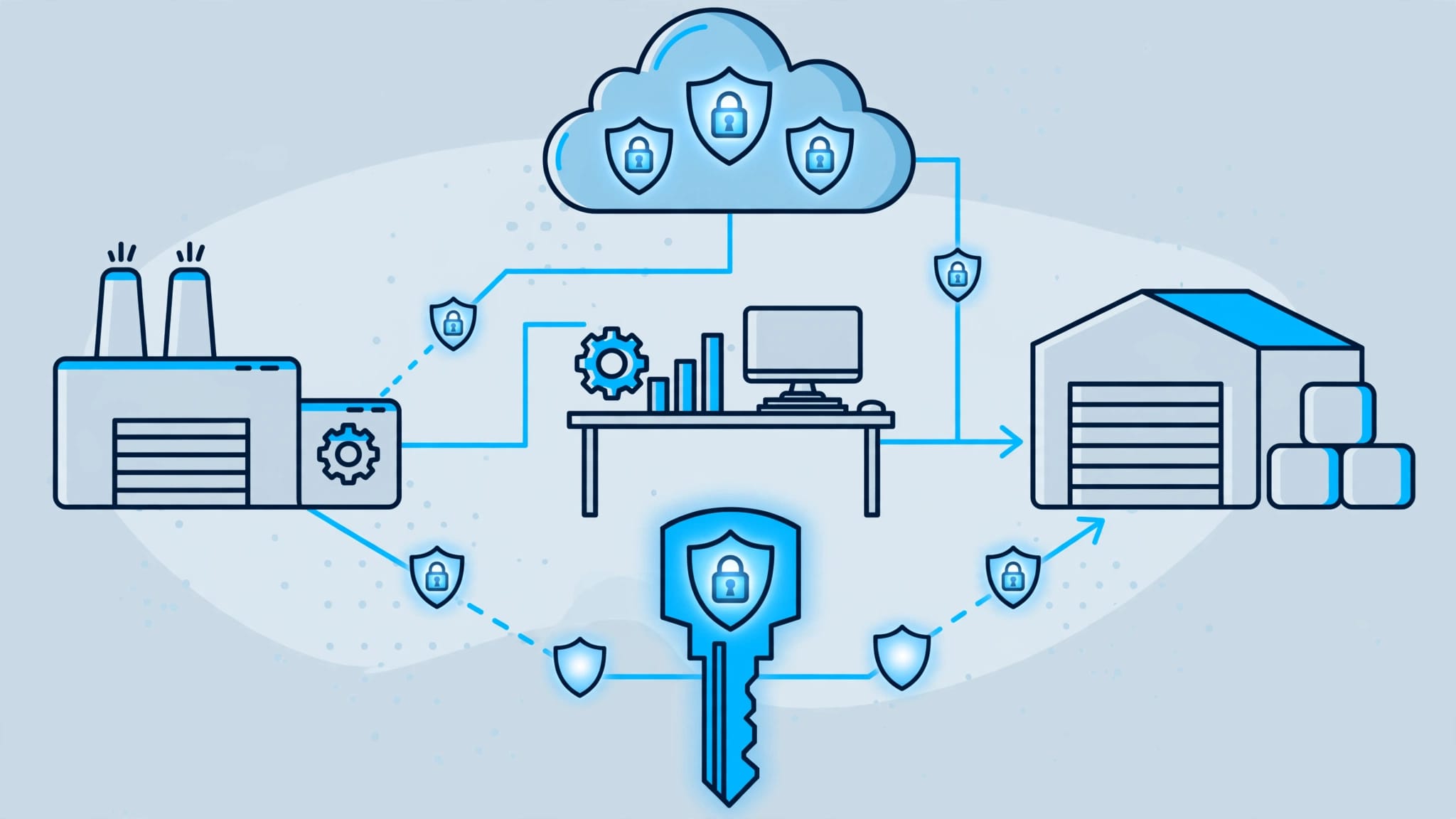
For TISAX compliance, automotive suppliers must protect sensitive information with cryptography that matches its classification, risks and customer obligations. Effective implementation covers stored information, secure transfers and the management of encryption keys.
For your organisation, the challenge is demonstrating that protection works across engineering systems, cloud services and supplier exchanges. Start with information ownership, then connect each protection requirement to a working control and reliable assessment evidence.
What TISAX means for automotive suppliers
TISAX stands for Trusted Information Security Assessment Exchange. Established in 2017, it was defined by the ENX Association on behalf of the VDA, the German automotive industry association.
The ENX TISAX scheme standardises assessments and allows participants to share results with authorised automotive partners. It builds on ISO/IEC 27001 principles through the VDA Information Security Assessment catalogue, or VDA ISA.
The catalogue covers information security, prototype protection and data protection. Physical safeguards can include restricted photography, secure transport and controlled disposal.
OEMs including Volkswagen, BMW and Mercedes-Benz, formerly Daimler, require TISAX results in relevant supplier relationships before sharing confidential designs, other intellectual property, vehicle-development information or test data. Requirements depend on the work and customer agreement.
Upstream Security's 2025 report recorded 409 automotive and smart-mobility cybersecurity incidents in 2024, compared with 295 in 2023. These cyber threats can expose supplier information, and around 60% of the incidents involved data and privacy. GDPR applies where personal data is in scope.
1. Define scope and assessment depth
First, identify the legal entities, sites, systems and outsourced services handling automotive information. Include development environments and backups, not only the production systems visible to customers.
Next, connect customer requirements to assessment objectives. A design agency holding CAD files faces different risks from a logistics provider transporting test vehicles.
The TISAX Participant Handbook distinguishes three assessment levels.
Level | Assessment approach | Practical meaning |
AL1 | Internal self-assessment | Internal review without a TISAX label |
AL2 | External assessment, evidence review and expert interviews | Plausibility-based review by an approved provider |
AL3 | Detailed external assessment, interviews and on-site inspection | Higher assurance for very high protection needs |
AL3 applies to objectives involving very sensitive information and requires an on-site inspection by an independent assessor. However, assessment levels describe review depth, not different encryption algorithms.
Also distinguish assessment level from control maturity. The VDA ISA maturity level concerns how consistently controls operate; AL2 or AL3 describes how the assessor examines them.
Our guidance on TISAX information classification explains how data classification connects sensitivity decisions to handling rules and evidence. Classification should determine where encryption is necessary and what additional safeguards apply.
2. Apply TISAX encryption controls across data flows
A cryptographic policy should define approved technologies, responsibilities and exception handling. ISO's information security controls overview places cryptography alongside access control, physical security and other safeguards.
The following are practical implementation choices, rather than a universal TISAX product specification.
Protect stored information and backups
Map confidential automotive information across laptops, file servers, databases, cloud storage, removable media and backups. Then apply encryption according to protection needs and contractual requirements.
BitLocker and FileVault are established options for endpoint disk encryption. However, disk encryption mainly protects data when a device is locked or powered down. It doesn't prevent an authorised account, or malware using that account, from reading accessible files.
For cloud services, document whether encryption is enabled by default, who controls the keys and which storage locations it covers. Backup encryption must also support reliable recovery. Test restoration with the required keys available through an authorised process.
Secure transfers and development environments
For secure data transfer, use protected channels for engineering exchanges, supplier portals, APIs and remote administration. TLS 1.2 or TLS 1.3, configured securely, are common implementation choices; remove obsolete protocols.
Apply the same reasoning to development and test environments. Copying confidential production files into an unprotected test system creates another exposure, even when the original repository is encrypted.
Also define approved transfer methods for subcontractors. An encrypted attachment offers limited protection if staff send its password through the same compromised mailbox.
3. Manage encryption keys and identities together
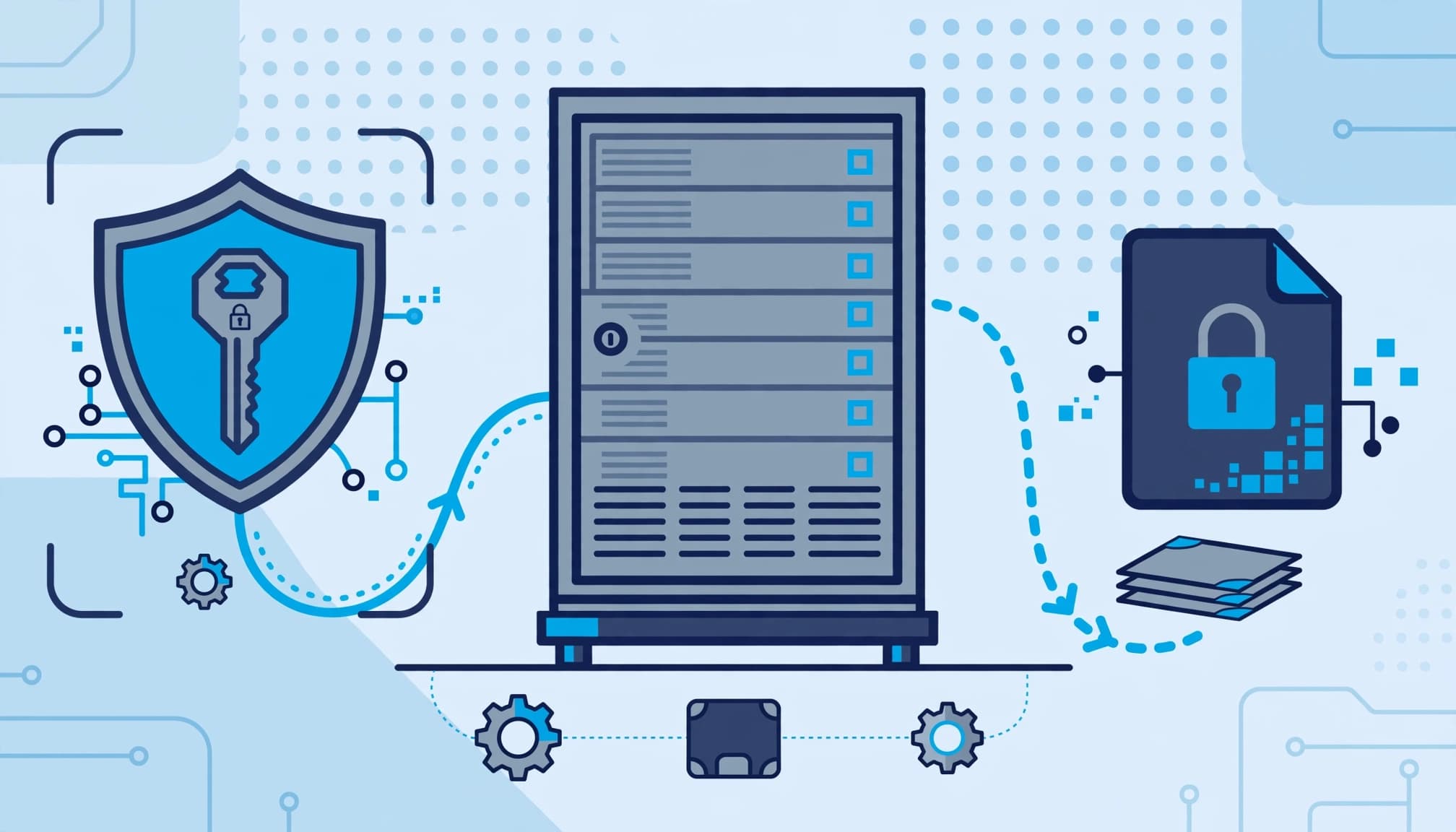
Encryption depends on access to its keys. Therefore, assign ownership for cryptographic services and separate operational responsibilities where the risk justifies it.
Control the complete key lifecycle
Document how your organisation generates, stores, distributes, rotates, revokes and destroys keys. Define rotation according to risk, technology and contractual requirements rather than applying an unsupported universal interval.
Use an appropriate key-management service or hardware security module where the protection need warrants it. Keep recovery material outside the ordinary access path to the encrypted information.
Record certificate ownership and expiry dates too. An expired certificate can interrupt an engineering exchange, while a lost backup key can make recovery impossible.
An encrypted backup can become unrecoverable if its only recovery key sits inside that same backup.
Restrict access and retain traceability
Identity and access management (IAM) supports encryption through least-privilege authorisation, privileged-access controls and prompt removal of unnecessary access. Apply multi-factor authentication to administrative access where appropriate.
Retain records of access approvals, privileged activity and changes to permissions. Assessors need traceability when an administrator grants access to a sensitive repository or changes key-management settings.
Also distinguish technical capability from actual configuration. A cloud platform may support customer-managed keys, but that doesn't demonstrate that your organisation enabled or governed them. Evidence should show the settings operating within your assessment scope.
4. Prepare evidence before independent assessment
TISAX auditing examines whether controls operate consistently. A policy library supports preparation, but operating records demonstrate implementation.

Turn the gap analysis into corrective action
Compare existing controls against the applicable VDA ISA requirements before engaging the external assessor. Record each gap with an owner, deadline, risk and evidence needed for closure.
Prioritise exposed confidential information, unmanaged keys and unclear supplier responsibilities. Then test the corrected control rather than closing an action because someone updated a document.
An existing ISO 27001 auditing programme can support this work. However, automotive-specific objectives still need their own evidence. A vCISO can coordinate ownership where your organisation lacks a dedicated security leader, whilst internal teams remain responsible for daily operation.
Build a traceable evidence register
Map each applicable requirement to its owner, evidence location, version and review date. Include the information security policy, physical access controls, classification rules, encryption configurations, secure development and test arrangements, and staff awareness records. Incident management records should show how suspected disclosures or key-related incidents are reported, assessed and addressed.
Technical samples should show endpoint encryption coverage, transfer settings, key-access logs and successful backup restoration. Our TISAX assessment evidence checklist provides a broader preparation structure.
TISAX training should teach staff approved sharing methods and incident reporting. ISO 27001 training can support wider awareness, but engineering teams also need customer-specific handling instructions.
Our TISAX consultancy and ISO 27001 consultancy support can help align these activities.
5. Maintain assurance and share results
Only an ENX-approved TISAX audit provider can conduct the formal external assessment. Select one from ENX's approved provider directory, with suitable capability for your locations and objectives. Independent assessment remains separate from preparation support.
VDA ISA 6.0 was released in October 2023; the updated 6.0.3 catalogue applies to assessments ordered during 2026. ENX's ISA2027 transition information explains the change for assessments ordered from 1 January 2027.
After a successful assessment, you control sharing through the ENX-managed online platform. A suitably scoped result can serve multiple OEM partners and reduce repeated assessments across supplier relationships in the supply chain.
TISAX labels are generally valid for three years. Renewal requires repeating the assessment process, so maintain controls and address changes throughout that period. A new engineering site, cloud migration or subcontractor can change the risks behind an earlier result.
Key takeaways for decision-makers
Base encryption decisions on information classification, customer obligations and the actual assessment scope.
Protect keys and administrative access alongside stored information and transfers.
Demonstrate implementation through configuration records, logs and recovery tests, supported by accountable control owners.
Treat the label as a shared assessment result with a defined scope and validity period.
Frequently asked questions
Does TISAX require AES-256 for every system?
TISAX doesn't impose one universal AES-256 requirement across every system. Cryptographic choices must suit protection needs, recognised technical practice and customer obligations. AES-256 is a common strong option, but algorithm strength alone doesn't establish compliance. Mode selection, implementation and key management also matter.
Can ISO 27001 certification replace a TISAX assessment?
ISO 27001 certification provides a useful management-system foundation, but it doesn't automatically produce a TISAX label. The automotive assessment examines applicable VDA ISA requirements and selected objectives within the defined scope.
Other frameworks have different purposes. CMMC addresses US defence contracting requirements, whilst ISO 42001 concerns AI management systems. Neither replaces a customer-required TISAX assessment.
Is prototype protection only about encrypted design files?
Prototype protection also covers physical vehicles, components and operational activities. Depending on scope, evidence can include restricted areas, visitor records, photography controls, protected transport and disposal arrangements. Encryption addresses digital exposure, while these controls address physical disclosure.
Build an evidence-led encryption programme
Effective TISAX encryption controls connect protection needs to deployed technology and demonstrable operating practices. Start with sensitive information flows, then establish clear ownership for encryption, keys and access.
Your assessment evidence should explain both the protection you selected and how your organisation maintains it.
If you would like to find out more information or require any of our services please Contact Us and complete our contact form.