
TISAX Data Disposal for Automotive Suppliers
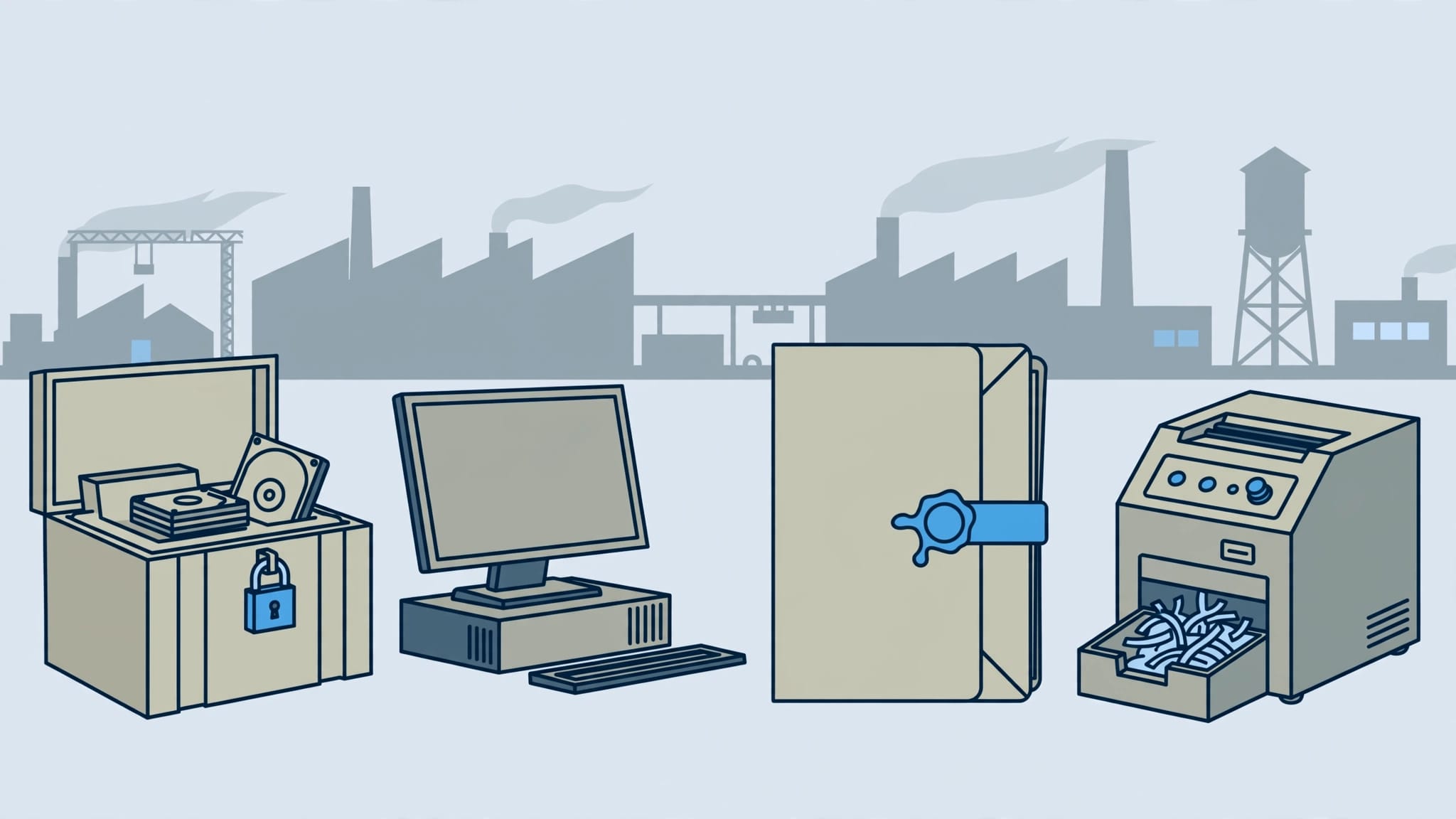
A TISAX-aligned IT asset disposal process retires equipment through authorised sanitisation, controlled handling and evidence linking each asset to its outcome. It must protect customer information, including when contractors transport or process hardware.
A recycling receipt alone doesn't demonstrate irrecoverable data removal, particularly for engineering systems and prototype equipment. Protect sensitive data throughout collection, transport and processing. Start with the information's sensitivity, then select the disposal method and records needed to demonstrate control.
What TISAX data disposal needs to demonstrate
Connect disposal to your assessment scope
TISAX is an automotive information security assessment and exchange mechanism operated by ENX, using the VDA ISA catalogue. It produces assessment results and labels, rather than ISO-style certification. The ENX TISAX overview explains this framework.
Disposal controls support TISAX compliance, but must reflect your selected objectives, locations and customer obligations. Include engineering offices, production-support systems and outsourced disposal services where they handle in-scope information.
An existing ISO 27001 management system provides a foundation, but doesn't automatically satisfy automotive-specific expectations. Annex A control 7.14 addresses secure disposal or reuse: equipment containing storage media needs checks that sensitive data and licensed software have been removed or securely overwritten.
Protect commercial information as well as personal data
Exposure can involve unreleased designs, production parameters and customer credentials, alongside personal information subject to UK GDPR.
IBM's 2025 Cost of a Data Breach Report recorded a global average cost of US$4.44 million, the first decline in five years. Disposal creates a preventable exposure: Blancco found recoverable personal data on 40% of used drives in its online-purchase study. ESET also found sensitive corporate data on over half of the second-hand routers it analysed.
These findings describe particular samples, not every discarded device.
Choose the sanitisation method for the media
NIST 800-88 distinguishes Clear, Purge and Destroy as data sanitization outcomes. Select the appropriate outcome according to information sensitivity, media technology and intended destination.
Clear addresses recovery through ordinary interfaces. Purge provides stronger protection against advanced recovery whilst potentially preserving reuse. Destroy renders the media unusable for storage and recovery infeasible through physical destruction.
This reference supports method selection, rather than guaranteeing an outcome for every device.
Media | Suitable approach | Main limitation |
Magnetic HDD | Validated overwrite, supported purge or destruction | Overwriting needs a functioning drive |
SSD or NVMe drive | Supported sanitise or validated cryptographic erasure | Ordinary overwriting can miss hidden blocks |
Backup tape | Appropriate degaussing or destruction | Degaussing must match the media |
Phone or tablet | Validated secure erase or cryptographic reset | Accounts and eSIMs need separate handling |
ECU or embedded flash | Manufacturer-supported sanitisation or destruction | Standard PC tools may not reach storage |
The device model and successful verification determine whether the chosen operation achieves the required outcome.
Handle SSDs and encryption correctly
Wear-levelling and over-provisioning can leave SSD data in remapped blocks that overwriting misses. Use supported ATA Sanitize, NVMe Sanitize or an appropriate NVMe Format secure-erase operation, with validated implementation and results.
Cryptographic erasure destroys the relevant encryption keys and is much faster than overwriting. However, it depends on sound encryption, complete coverage and removal of recoverable key copies.
Reserve destruction for unsuitable media
Degaussing neutralises magnetic recordings on compatible HDDs and tapes; it doesn't erase flash memory. The NSA Evaluated Products Lists identify evaluated equipment for particular sanitisation and destruction applications, rather than conferring TISAX compliance.
Destroy media when sanitisation fails or cannot provide sufficient assurance. Retain evidence of the data destruction method and affected serial numbers.
Follow a controlled IT asset disposal process
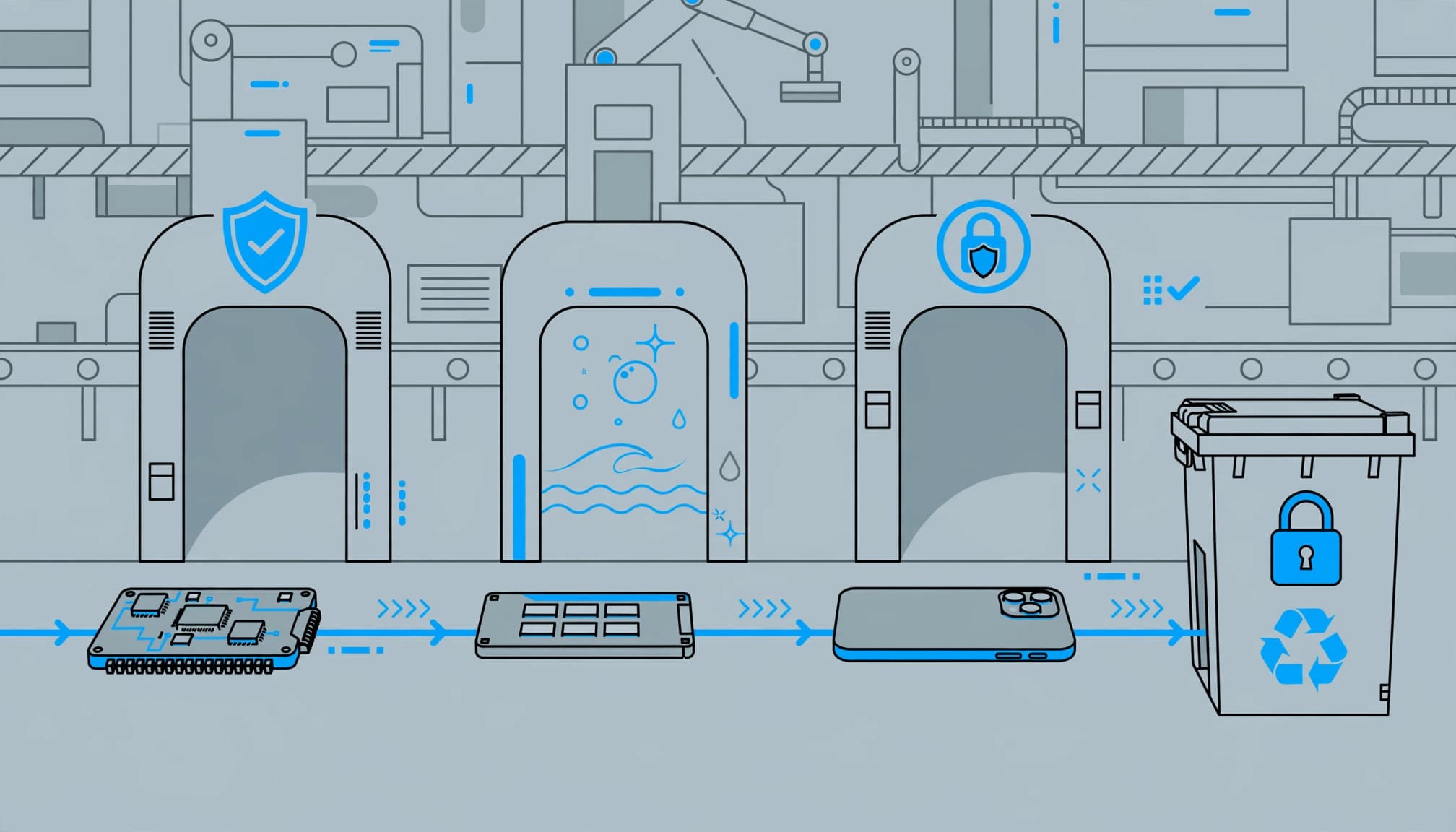
A defensible IT asset disposal process tracks ownership across the asset lifecycle, from retirement to final disposition. Your organisation accepts closure only after reviewing the final evidence. Our guidance on classifying automotive information helps connect protection requirements to disposal decisions.
Identify every data-bearing component. Record asset and media serial numbers, owner, location, classification and intended destination.
Authorise retirement. Resolve retention periods, customer restrictions and legal holds before transferring required records and approving erasure.
Prepare the equipment. A factory reset doesn't necessarily remove iCloud Activation Lock, Google Factory Reset Protection or other account bindings, so clear them through authorised procedures. Remove physical SIMs and delete or deactivate eSIM profiles.
Secure the collection. Restrict access to the holding area and record container seals, collection staff, quantities and handovers.
Apply the approved data sanitization method. Record the tool and version used for data wiping, the operation, outcome and any failures. Maintain security during any off-site processing.
Verify the result. Review completion status and errors, perform the prescribed validation and quarantine failures. A failed or incomplete wipe must block release.
Reconcile the shipment. Match every collected asset to a successful erasure record, destruction record or documented exception.
Approve closure. Update the asset register, retain evidence and authorise reuse, resale or recycling only after resolving discrepancies.
Lost equipment, broken seals or unexplained serial-number differences need escalation through your incident process. Don't close a disposal batch merely because the contractor has issued an invoice.
Include automotive plant and prototype equipment
Map storage inside production systems
A disposal inventory needs more than office laptops. ECUs, diagnostic tools, industrial PCs, human-machine interfaces and test rigs can retain sensitive data, including calibration files, logs or credentials.
Identify removable storage and embedded flash before dismantling equipment. Also consider controllers, attached PCs and storage modules within a larger machine. The external asset number may cover several data-bearing components.
For leased equipment, establish the sanitisation and return arrangements before collection. A lease ending doesn't remove confidentiality obligations.
Apply prototype handling rules to disposal
Prototype protection can continue after equipment stops working. Physical parts, markings and test assemblies may reveal customer information even after successful data erasure.
Use restricted storage, authorised transport and controlled destruction where customer requirements demand them. Consider reuse or refurbishment only after required sanitisation and customer controls are satisfied. Retain movement and handover records for sensitive prototype material.
TISAX training should help engineering and maintenance teams recognise these risks. Facilities staff need clear instructions to send unusable equipment through an approved e-waste route, not ordinary recycling collections.
Create evidence an assessor can follow

There isn't a universal TISAX certificate-of-erasure template. Evidence should help demonstrate compliance within your defined assessment scope. The TISAX Participant Handbook explains the formal assessment process.
Require a digitally signed erasure certificate for each sanitised asset, or an asset-level entry in a signed batch report. Your evidence checklist should cover:
Identify the asset by serial number, make and model, including separate media identifiers where applicable.
Record the sanitisation method, referenced standard, tool and version, date, technician, and explicit pass or fail outcome.
Retain verification results and link each certificate to collection manifests, handovers, the chain of custody and the final destination.
For physical destruction, retain the media inventory, destruction method, date, responsible operator and certificate of destruction.
A digital signature supports authenticity, but doesn't prove the right device underwent the right operation. Match identifiers against the original inventory and investigate duplicated serials, missing records or unexplained failures.
Store approved evidence in access-controlled, read-only folders where practical. Use meaningful filenames and remove superseded drafts from the assessment pack.
Our TISAX assessment evidence checklist supports broader preparation. Give corrective actions an owner, deadline and closure evidence; test the corrected process before accepting completion.
Set supplier obligations and management ownership
Assess the whole disposal chain
R2v3 or e-Stewards certification supports electronics-recycling assurance. NAID AAA addresses secure destruction practices; NAID AAA plus R2v3 is a useful procurement baseline where both destruction and recycling matter. A certified ITAD provider may suit this work, but credentials should match the services performed. These credentials aren't universal TISAX requirements.
Supplier due diligence must cover the facilities, transport arrangements and subcontractors performing the work. ITAD contracts should address confidentiality, approved methods, custody records, incident notification, subcontracting approval and evidence retention.
Secure reuse, including refurbishment, can support value recovery after successful sanitisation and evidence acceptance. The Global E-waste Monitor 2024 reported 62 million tonnes of e-waste generated in 2022, with only 22.3% documented as formally collected and recycled.
Assign accountability and practical support
Give an internal owner authority to approve methods and resolve exceptions. A vCISO can provide oversight where there's no full-time security leader.
ISO 27001 training and internal auditing can support shared controls. However, TISAX assessment preparation still needs automotive-specific evidence. TISAX consultancy should connect those obligations to operational practice.
Book a complimentary 30-minute consultation with Anya Krupina, Founder of AKRUP and information security specialist. We can discuss your disposal controls, assessment requirements and next steps.
Key takeaways for accountable disposal
Secure disposal depends on asset-level traceability. Classification determines the required protection; media technology determines the workable method. Ownership then continues through transport, sanitisation and evidence acceptance.
A contractor's certification supports supplier assurance, but your organisation still needs records showing what happened to its equipment.
Frequently asked questions
Does a factory reset completely erase a device?
Deleting files usually removes references without reliably sanitising the underlying data. Factory resets vary: some modern encrypted devices use effective cryptographic erasure, whilst other resets provide insufficient assurance.
Therefore, accept a reset only where the device's implementation and completed operation meet your approved sanitisation requirements. Treat activation locks and eSIM profiles separately.
Can one disposal policy support several frameworks?
Yes. Shared asset records, approvals and custody controls can support multiple obligations. However, CMMC concerns defence-contract information, whilst ISO 42001 addresses AI management systems.
Map shared evidence to each applicable requirement. Neither framework replaces the automotive scope, objectives or operating evidence required for TISAX.
Make disposal closure an evidence-based decision
TISAX data disposal works when your organisation can account for every sensitive asset and demonstrate its final treatment. A successful wipe, documented custody and reconciled records provide stronger assurance than a recycling receipt alone.
Start by sampling completed disposals against your approved process. Resolve missing identifiers, unsupported methods and incomplete evidence before the next collection.
If you would like to find out more information or require any of our services please Contact Us and complete our contact form.